
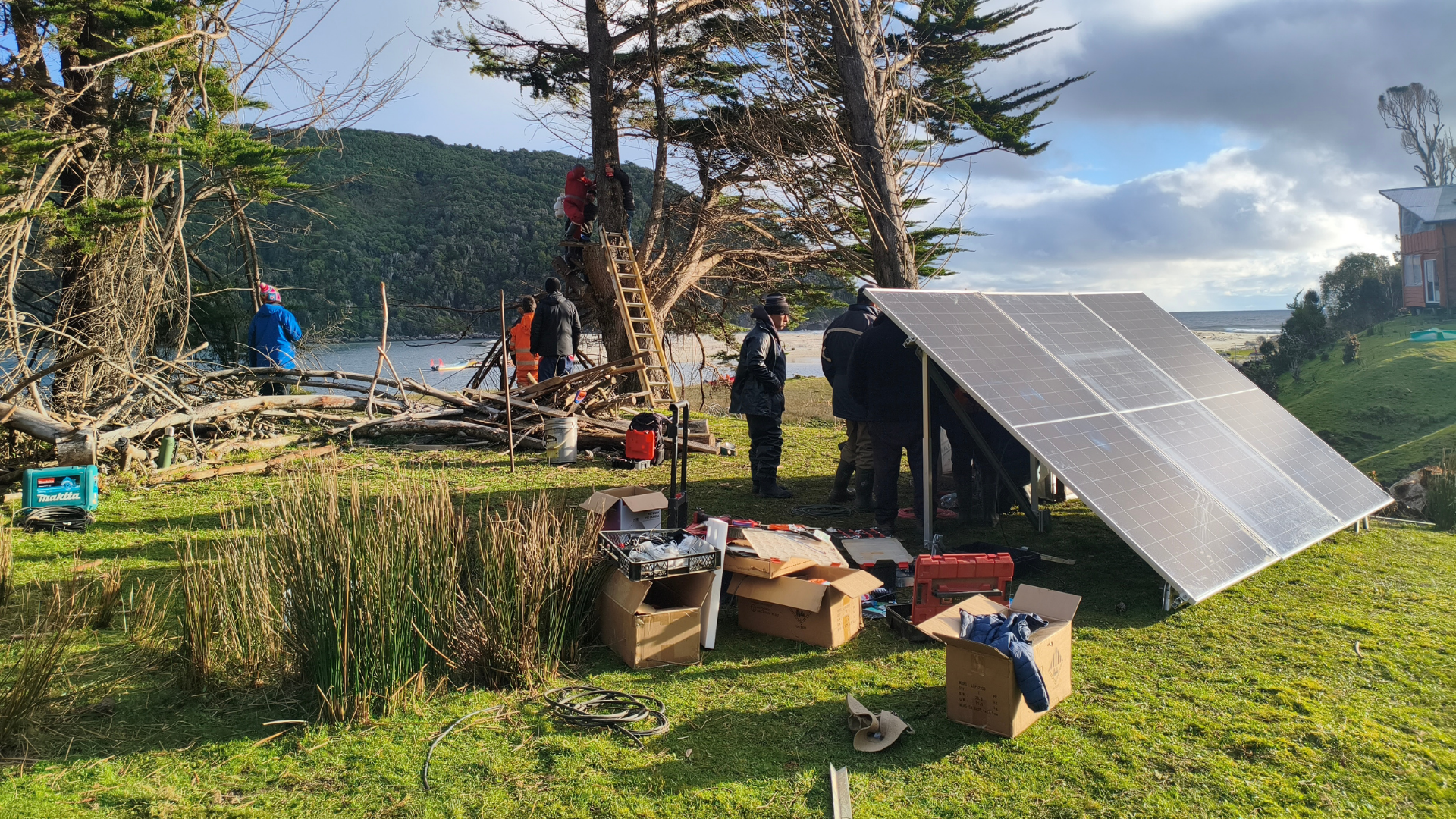
The measure is part of the protection and restocking efforts for the natural choro zapato mussel bed in the Huellelhue river estuary, carried out with support from the GEF Biodiversity Conservation Incentives project.
Original information from the GEF Biodiversity Conservation Incentives project.
September has been a month full of activities aimed at strengthening the community-based model for the recovery of the natural choro zapato mussel bed (Choromytilus chorus) in Huellelhue, in the municipality of Río Negro, Los Lagos Region. The choro zapato is a hydrobiological resource of high socio-ecological value for the Indigenous and coastal communities living in this territory, and it is also one of the conservation targets of the Lafken Mapu Lahual Multiple-Use Conservation Area (MUCA LML).
Within this framework, the Demonstration Experience of the GEF Incentives project, carried out together with Centro de Pesca Sustentable, supports and strengthens a governance, monitoring and protection system, in order to reinforce a community management plan that enables the restoration of this estuarine ecosystem.
As part of these efforts, a recent milestone is the installation of a 360° camera at a strategic point to safeguard the choro zapato bed. This technological measure, powered by a stand-alone solar energy system, will allow for greater protection and early detection. This community protection and monitoring setup will be managed by representatives of the communities and organizations of the territory themselves, as a tool to support the conservation of the natural bed.
Alongside the installation, a testing period is planned, covering both its operation and the internet system that will support its full and continuous functioning, which will also improve connectivity for the locality. This technology, its features and its protocols of use are being defined in the context of strengthening collective protection for the recovery of this important resource.
Amerindia Jaramillo, national coordinator of the GEF Biodiversity Conservation Incentives project, highlighted the progress of this work: "For the GEF Incentives project, the work carried out in the Huellelhue Demonstration Experience is an example of collaboration between communities, science and technical education, aimed at the sustainability and recovery of the coastal ecosystems of southern Chile through the restoration of the natural choro zapato bed in the estuary. This experience has made it possible to combine scientific knowledge with the traditional knowledge of artisanal fishers and Indigenous communities in the area, strengthening local work and promoting sustainable practices."
The installation of this monitoring system was discussed and decided by the local communities and organizations themselves. As a result, the system will follow principles and guidelines agreed upon by local residents, through a Good Monitoring Practices protocol intended to establish responsible management by the organizations that make up the Caleta Huellelhue Territorial Coordination Roundtable.
On this point, Rubén Romero, president of the Caleta Huellelhue Territorial Coordination Roundtable, underscored this new step for the protection of the resource: "The installation of the camera in Huellelhue is a system that will give us strong support for surveillance, so we can safeguard and look after the product known as choro zapato. I believe that surveillance will allow us to report to the authorities and to be the ones with the authority to look after the product and prevent it from being harvested carelessly […] We are pleased with the installation of the camera and its system, and I think it is a very good initiative."
Indigenous knowledge and science together to restore the choro zapato in southern Chile
The Caleta Huellelhue Demonstration Experience is part of years of work carried out by the communities and organizations of the territory, under a model that seeks to combine the conservation of the choro zapato, the protection of the ecosystem and economic development at the local level.
Its coast and part of the Huellelhue River lie within the Lafken Mapu Lahual Multiple-Use Conservation Area (MUCA LML), created in 2005, which covers 4,463 hectares of marine and coastal areas in the province of Osorno. The MUCA LML management plan, approved in 2019, recognizes the choro zapato, along with other species, as one of the conservation targets of this area, and stresses the importance and urgency of management actions for its recovery. That same year, a harvesting ban was imposed on the natural choro zapato bed in order to reverse its overexploitation and secure the sustainability of this resource over time. The measure has been maintained since then, and a harvesting ban on choro zapato (Choromytilus chorus) and Chilean mussel (Mytilus chilensis) is currently in force across the entire Lafken Mapu Lahual MUCA until March 2028.
In this context of restoring the ecosystem and its biodiversity, during 2025 and early 2026 local fishers and divers carried out sessions to collect adult specimens directly from the estuary. These broodstock act as the "mothers and fathers" that produce new individuals; they were taken to the hatchery of the Mehuín Polytechnic Fisheries High School, where students and teachers induced the formation of larvae, which were fed with microalgae produced at the same hatchery until they became small seed. After several months of cultivation, under strict controls of temperature, oxygen and salinity, more than one million seed reached the right size to be returned to their natural environment, and were seeded on culture lines in the estuary to be conditioned and later reintroduced into their habitat.
It is worth noting that this process is ongoing: professionals from the Restocking and Culture Department (DRC) of the Fisheries Development Institute (IFOP) continue to produce seed from Huellelhue broodstock at the Hueihue Mariculture Center facilities in Ancud, Chiloé.
From the culture lines installed in the Huellelhue River, the seed will be moved to strategic areas that historically held high abundances of this resource. These areas will be monitored and protected, allowing the mussels to reach a suitable size for eventual harvesting and consumption.
Amerindia Jaramillo, of the GEF Incentives project, adds that the plan is to bring this work into the future Biodiversity and Ecosystem Services Certification System (SCB), established by Law 21,600. "As a project, we want this work of implementing good practices in marine protected areas to be incorporated later into the future Biodiversity and Ecosystem Services Certification System, which will be administered by SBAP, so that these management practices can be certified and add value to the choro zapato from this area, recognizing the knowledge and the contribution this community has made for more than a decade to the care and protection of the biodiversity of this estuary."
This work also involves many other actors, among them the Ministry of the Environment through its regional office, the Biodiversity and Protected Areas Service (SBAP) and the Restocking and Culture Department (DRC) of the Fisheries Development Institute (IFOP) in the Los Lagos Region, in constant dialogue and feedback with the fisheries authorities and the maritime authority. The Demonstration Experience thus stands as an example of collaboration between communities, institutions, science and technical education, aimed at the sustainability and recovery of the coastal and estuarine ecosystems of southern Chile.
As for the monitoring system, this technological solution is being designed taking into account the socio-environmental conditions of Huellelhue, local knowledge and the needs defined by the communities and organizations in Huellelhue, with the aim of contributing to the protection, recovery and sustainability of the choro zapato in this territory.
Miguel Espíndola, Director of Ocean Conservation at Centro de Pesca Sustentable, the organization providing technical support to the community in the Demonstration Experience, highlights local participation and knowledge throughout the process: "The people who live there are the ones who know the Huellelhue territory best, and that knowledge has been decisive in deciding where to seed the mussels and, now, where to install the protection system. But beyond providing information, it is the community itself, through its Territorial Roundtable, that has decided what kind of monitoring system it needs and how it should be managed. That capacity, together with their genuine interest in restoring their ecosystems, is what sets this project apart and what guarantees solutions that will last over time."
The GEF Biodiversity Conservation Incentives project (GEF ICB) is executed by Chile's Ministry of the Environment and implemented by the United Nations Development Programme (UNDP), with funding from the Global Environment Facility (GEF).